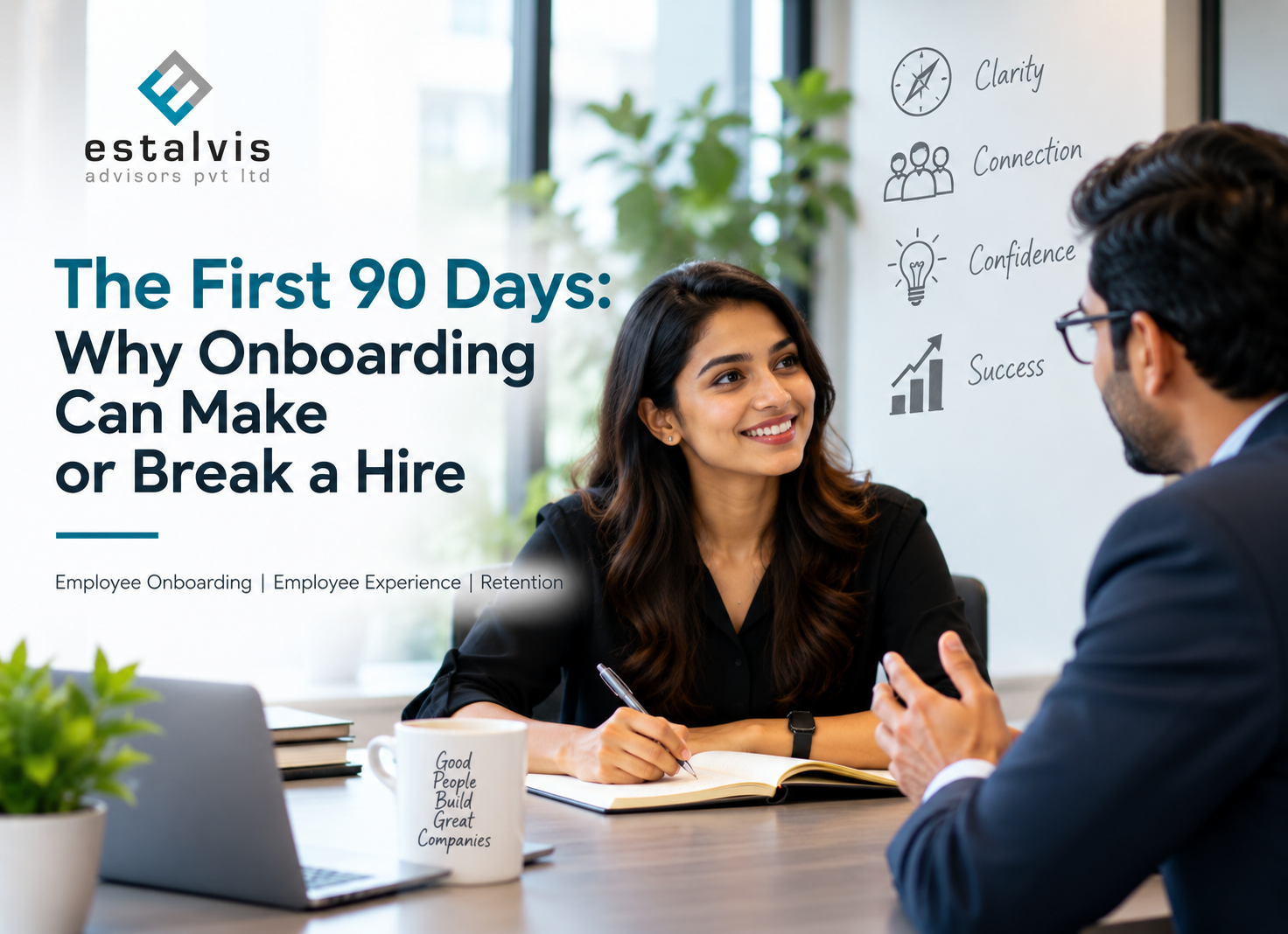
The First 90 Days: Why Onboarding Can Make or Break a Hire
- By Estalvis Advisors
- September 25th 2026
The offer is accepted. The joining date is confirmed. Everyone moves on to the next vacancy.
But for the new employee, the real journey has only just begun.
Businesses invest significant time and effort in finding the right person. Yet once the candidate joins, onboarding is often treated as an administrative exercise — documents, introductions, a laptop and a few emails.
The first 90 days can strongly influence how a new employee understands the organisation, builds confidence, performs in the role and decides whether they see themselves there for the long term.
Onboarding Is Not a Joining-Day Activity
A joining date is not the finish line of recruitment.
It is the beginning of the employee experience.
A new employee is quietly asking:
- What exactly is expected of me?
- What does success in this role look like?
- Who do I go to when I need help?
- How does this organisation actually work?
- How will my performance be evaluated?
If these questions remain unanswered, even a strong candidate can struggle to find their footing.
A good hire does not automatically become a successful hire. The environment they enter matters.
What Weak Onboarding Can Cost
The consequences rarely appear as an obvious "onboarding problem."
They may show up as slower productivity, confusion around responsibilities, frustration between the employee and manager, or difficulty integrating into the team.
Eventually, an organisation may conclude:
"This person wasn't the right fit."
But was the hiring decision actually wrong?
Or was the employee simply never given enough clarity, context and support to succeed?
Sometimes what looks like a hiring problem is actually an onboarding problem.
What Should the First 90 Days Look Like?
Effective onboarding does not need to be complicated. It needs to be intentional.
First 30 Days — Understand
The employee should gain clarity about the role, team, organisation, expectations and immediate priorities.
Days 31–60 — Contribute
The focus should gradually shift towards taking ownership, understanding priorities and building effective working relationships.
Days 61–90 — Perform
The employee should increasingly operate with confidence and independence, while managers assess progress, address challenges and provide timely feedback.
The organisation should also ask:
Is this working relationship developing as we expected?
That question shouldn't wait until the annual performance review.
Onboarding Is Also a Test for the Organisation
Onboarding isn't only about helping an employee adjust. It gives the organisation an early opportunity to validate the hiring decision.
Are expectations aligned on both sides?
Does the role match what was communicated during recruitment?
Is the employee demonstrating the capabilities expected?
Is the manager providing the support required?
The first 90 days create an important connection between:
Hiring → Onboarding → Performance → Retention
From Hiring a Person to Building a Relationship
Recruitment should not end when the candidate accepts the offer.
The real objective is not simply:
"We filled the position."
It is:
"We enabled the person we hired to succeed."
At ESTALVIS Advisors, we believe talent acquisition is part of a larger talent lifecycle. Our HR solutions span talent acquisition, leadership hiring, capability assessment and other people-focused requirements that help organisations build stronger teams.
Because finding the right person is only half the job.
Giving them the right beginning is what helps turn a hiring decision into a successful working relationship.
If you are looking to strengthen your hiring and onboarding processes, discuss your HR requirements with us.
ESTALVIS Advisors
Your HR Solutions Partner