Why the Best Candidate on Paper May Not Be the Best Hire
- By Estalvis Advisors
- August 14th 2026
A strong résumé can get a candidate through the door. A good interview can create a positive impression. But neither necessarily tells you whether that person will succeed once they join the organisation.
This is one of the most common challenges in hiring: the candidate who looks perfect on paper does not always become the employee who performs best in the role.
A candidate may have impressive qualifications, relevant experience and a successful track record. Yet, after joining, they may struggle to adapt, work under pressure, collaborate with others or take ownership.
So, what went wrong?
Often, organisations evaluate what a candidate has done without looking closely enough at how the candidate thinks, behaves, adapts and works with others.
A Résumé Tells You Where Someone Has Been
A résumé is an important starting point. It tells us about education, experience, responsibilities and achievements.
But two candidates with similar résumés can have very different capabilities.
One may have successfully handled ambiguity and changing priorities, while another may have performed well only within a highly structured environment.
One may have developed teams and successors, while another may have relied primarily on personal expertise.
The résumé may look similar. The underlying capabilities may not be.
That is why hiring decisions need to go beyond credentials and career history.
Interviews Are Important — But They Are Not Enough
Interviews remain an essential part of recruitment. However, they can sometimes favour candidates who are particularly good at presenting themselves.
A confident and articulate candidate may give excellent answers to questions about leadership, teamwork or handling difficult situations.
The more important question is whether their past behaviour consistently demonstrates the qualities required for the role.
Can they make sound decisions? Do they take ownership? How do they respond to feedback? Can they manage disagreement constructively?
These are qualities that deserve structured evaluation.
What Should Organisations Assess When Hiring?
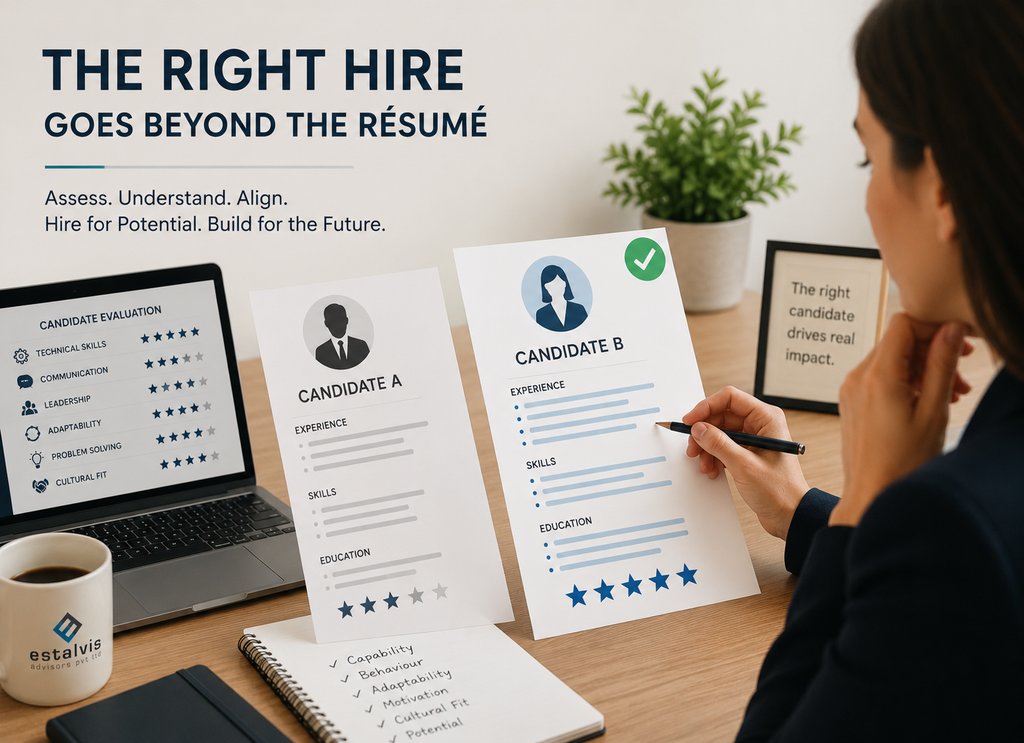
A stronger hiring process looks at several dimensions:
Capability: Does the candidate have the functional and problem-solving skills required for the role?
Behaviour: How do they typically respond to pressure, conflict, feedback and responsibility?
Adaptability: Can they succeed when priorities change or when they move into a different organisational environment?
Motivation: Is the role genuinely aligned with their aspirations and expectations?
Leadership potential: For managerial roles, can they build teams, delegate, develop people and create accountability?
These factors can make the difference between a candidate who simply meets the job description and one who succeeds in the role.
The Role of Structured Assessment
Psychometric and capability assessments can provide an additional layer of insight into a hiring decision.
They should not replace interviews or professional judgement. Instead, they can complement them by helping organisations understand behavioural tendencies, cognitive capabilities, decision-making approaches, interpersonal styles and other competencies relevant to the role.
The objective is not to reduce a candidate to a score.
It is to create a more complete picture of the individual before making an important hiring decision.
The Real Question Is: "Is This the Right Candidate?"
Perhaps the most important shift organisations can make is to stop asking only:
"Is this a good candidate?"
and instead ask:
"Is this the right candidate for this role, this organisation and this stage of growth?"
A highly entrepreneurial professional may thrive in a start-up but struggle in a highly structured organisation. A technically brilliant individual contributor may not necessarily have the people skills required for leadership.
The candidate isn't necessarily "good" or "bad."
The real question is fit between the individual and the opportunity.
The Estalvis Perspective
At Estalvis, we believe talent acquisition should go beyond matching a résumé to a job description.
The right hire is someone whose capabilities, behaviour, aspirations and potential align with what the organisation actually needs.
Because ultimately, a hiring decision isn't measured on the day the offer letter is signed.
It is measured by the value the person creates after they join.
Looking for the right talent for your organisation?
At Estalvis Advisors, we help businesses identify, assess and hire talent that fits both the role and the organisation.